Best red light book light for reading in bed: the sleep-friendly amber & red reading lights that won't disrupt your melatonin
We may earn a commission if you buy through these links — at no cost to you.
Short answer: buy a clip-on book light whose lowest setting is a true red or deep amber (roughly 1800K amber or 630nm red), and read by that setting, not the white one. The overhead lamp and the phone screen are the two mistakes and they are the same mistake: blue light at the page before bed tells your circadian system it is still late afternoon. A dedicated red or amber book light attacks the problem at the page itself, costs the price of a takeaway, and is the one impulse buy in the sleep aisle that is actually about sleep rather than about a habit. This guide is for people who read in bed and want to keep doing it without paying for it in sleep quality.
How we picked these
The light you read by is a sleep decision, not a lighting decision
Reading in bed is one of the most reliable wind-down rituals there is — until the light it happens under works against the sleep it is supposed to lead to. Bright, cool, or blue-ish light reaching your eyes in the evening suppresses melatonin, the hormone that gates your entry into sleep, and tells your circadian clock that daylight is still going on. This is the same mechanism that makes the blackout mask and the room-darkening curtain useful during daytime sleep, applied at the wrong end of the day.
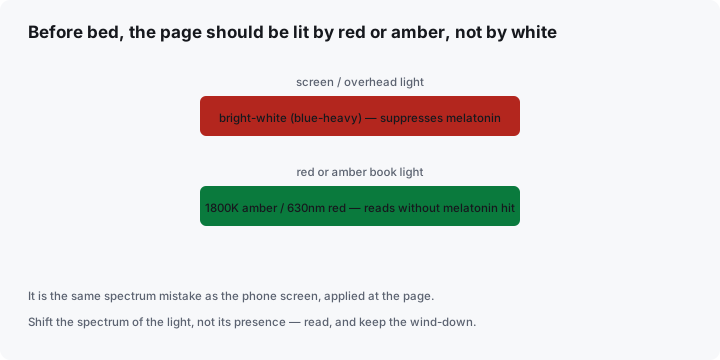
The fix is not darkness — it is that you cannot read in darkness. The fix is to shift the spectrum of the light, not its presence. Warm amber light around 1800K, and true red light around 630nm, carry little of the short-wavelength blue that drives the suppression. That is the entire thesis of this category, and it is why the “red book light” is a real product type rather than a gimmick.
The trap: a “reading light” that is only a dimmer white light
Most book lights sold on Amazon are ordinary white LED clip lights with a brightness dial. Dialling one down dims it but does not remove the blue. When the seller says “eye-care” or “warm”, check what it actually means: a low colour temperature (1800K–2700K) or a red wavelength (roughly 610–640nm) is what removes the short-wavelength component. A lamp that merely calls itself “warm white” at 3000K is a step in the right direction but still carries more of the suppressing spectrum than a true amber or red mode.
What to check on the listing: the colour temperature in Kelvin (a number, not the word “warm”); whether there is a separate red or amber mode as opposed to a single white dial; a “blue-light blocking” or “no blue emitted” claim backed by a Kelvin or wavelength figure; flicker-free or DC claim; and a rechargeable battery, because a book light is a buy-once object you will use nightly.
Verdict blocks: read these honestly before any listing
Best overall: the red-and-amber clip light
This is the pick for almost everyone: a clip-on light with both a true 630nm red mode and a deep 1600K amber mode, because it gives you the full before-bed range in one device from the brightest reading you need to the dimmest sleep-gate you want to fall asleep under.
Who it is for: the reader who wants to read in bed and then sleep — you get even full-page coverage to actually finish the chapter, plus a red setting that is gentle enough to fall asleep with the light still attached and on.
Who it is not for: the person who only ever wants a dim nightlight and reads nothing — you would be buying far more than you need; and the maximalist who wants a lamp that illuminates the whole room rather than one page (for that see the circadian bulb guide, not a book light).
When to buy vs wait: this is a sub-thirty-dollar item, so the honest answer is there is no meaningful “wait” column — the failure risk is buying the wrong spectrum, not the wrong time. If you already own a general book light, try its amber setting (if it has one) before spending; the upgrade is justified the moment you catch yourself using your phone’s light or the overhead lamp instead.
Best value / most-proven: the pure amber-and-red dual light
This is the small-business bestseller that made the category — a compact clip light with a 1600K amber mode and a separate 625nm red mode, sold in huge numbers for a reason. The short answer wants this one if you want the most bedroom-proven barrel of the category and want to spend as little as possible while still getting a true amber and red choice.
Who it is for: first-timers who are not sure the ritual will stick, and gift buyers — it is the category’s safest, most-answered pick, light enough to clip on a paperback and simple enough to hand to a partner or a kid.
Who it is not for: the reader who needs one wide light to cover a large hardcover page edge to edge without re-positioning — this one is smaller than the wide-head clip lights and is about the spectrum, not about the widest beam.
When to buy vs wait: buy when you are ready to actually switch your whole evening reading to red or amber — on its own it is a small thing, and it pays off when it is the only light you read by. There is no seasonal or price-wait; the only wrong time to buy is if you will not change the habit.
Best budget: the amber-sleep-mode bestseller
This is the Amazon best-seller clip light that happens to include a genuine 1800K amber sleep mode with stepless dimming, usually the least you can spend for a book light with a real amber setting at all.
Who it is for: the budget-first reader who wants a normal, proven, hugely reviewed clip light that still has the amber setting you actually need before bed.
Who it is not for: the person who specifically wants a red wavelength mode rather than amber — this one’s sleep setting is amber, not 630nm red; and anyone whose priority is pure sleep fidelity over page brightness.
When to buy vs wait: buy if the amber threshold is enough for you and money is the constraint — there is no cheaper way into a genuine amber before-bed setting. If red-only fidelity matters, wait and buy one with a red mode instead; the few extra dollars buy the thing you actually wanted.
Best hands-free: the bendable neck light
This is the wearable neck light — two articulating heads on a collar that lights your book from both sides while your hands stay free to hold the book any way you like, with warm modes for the bed.
Who it is for: the reade-for-longer-in-bed person who hates holding the book under a single clip, who reads side-on, or who wants the same light for knitting, crafting, or journaling in bed.
Who it is not for: the minimal night reader — it is bulkier than a clip and there is a back-plate you will feel if you lie back on it for a long time; and anyone who already has a clip they love.
When to buy vs wait: buy it if hands-free is the real obstacle to reading in bed (it often is when one hand is holding the book and the other is turning pages). Wait if you read for twenty minutes with a clip — a neck light is a comfort upgrade, not a sleep-spectrum necessity.
The comparison at a glance
| Red + amber clip (best overall) | Amber + red dual (best value) | Amber-mode clip (best budget) | Neck light (best hands-free) | |
|---|---|---|---|---|
| Sleep spectrum | True 630nm red + 1600K amber | True 625nm red + 1600K amber | 1800K amber sleep mode | Warm modes only |
| Page coverage | Wide, even, full page | Compact, single area | Good, stepless dim | Two heads, both sides |
| Hands | Clips to the book | Clips to the book | Clips to the book | Free (worn) |
| Typical price class | Low–mid twenties | Mid teens | Around ten | Upper teens–twenties |
| Best for | The full before-bed range | First-timers, gifts | Budget amber entry | Long hands-free sessions |
Prices are ranges and move; we do not quote exact prices because Amazon’s terms let them be quoted only where Amazon itself serves the data, and a hard-coded number is wrong the week after it is written.
What real first-time buyers miss
- You cannot buy “red” with a white-light dial. A light whose cheapest trick is “warm” at 3000K is not the same as one with a 630nm red mode. Check the Kelvin or the wavelength, not the word on the box.
- The widest beam beats the brightest. A single narrow hotspot that you must keep nudging to cover the page is more annoying than a dimmer wide head. Wide, even coverage is what lets you actually finish the chapter; that is why the best-overall pick has a wide head, and why the cheap ones with a pointed beam frustrate people.
- Dimness at maximum is not failure — it is the point. Your newest instinct is to crank it. For sleep purposes you want bright enough to read and no brighter, and a light that is “too dim” at top setting on the red mode is usually working as intended for melatonin.
- Charge it before the first bedtime, not after a dead battery at 11pm. Rechargeable is non-negotiable, but every one of these ships partly charged. Top it up the afternoon you open it.
- The spectrum fix is one of four. A red book light does not fix the phone glow beside it. If you check your phone under the covers as you close the book, you just re-imported the blue at the last minute. The light works the way a blackout curtain does: it is one clean lever, used with the others, not a vaccine.
The order, one line
Choose a clip light with a true red or deep-amber mode (not a white dial), prefer the wide-head one if you read whole chapters, add a second red source only if the overhead needs replacing, and treat the red light as one of several sleep levers rather than the whole fix.
Best overall: the red-and-amber wide-head clip light
The wide-head clip light with both a true red and a deep-amber mode is the honest buy for almost everyone: the Glocusent Red & Amber Clip Book Light gives you even, full-page coverage so you can actually read, and a red setting gentle enough to fall asleep under. Everything else in this category trades away either the spectrum or the coverage; this one gives you both, which is why it is the one to start with.
Who it is for: for the reader who wants to finish the chapter and keep the wind-down light — the even wide beam does the reading, and the red mode does the sleep-gating. It is the best buy for first-time readers of the category.
Who it is not for: for the pure nightlight user who only wants a dim glow and reads nothing — you would be paying for page coverage you do not use.
Glocusent Red & Amber Clip Book Light
Wide full-page head with a true 630nm red mode plus a 1600K amber mode
Cheap enough to be an impulse buy, but this is the rare sleep-aisle impulse that is actually about sleep: the red mode does the reading without suppressing melatonin.
Check the current price on Amazon ›Common questions
Does reading under a red light actually help you sleep?
Red light carries little of the short-wavelength blue that suppresses melatonin, so reading by true red or deep amber (around 1800K or 630nm) removes the chief way evening light works against sleep. It is one clean lever — the phone screen and the overhead lamp are the mistakes it fixes.
What’s the difference between amber and red book lights?
Amber is a warm colour temperature (roughly 1800K) that is almost entirely free of the blue end of the spectrum; true red is a red wavelength (roughly 610–640nm) that contains no blue at all. Both are before-bed-appropriate. Red is the strongest sleep-gate setting; amber usually reads more clearly as “light” for an evening.
Can I use a regular book light for this?
A regular white book light dialled down is still a white light and still carries the blue. What matters is a low colour temperature in Kelvin or a separate red mode — check the number, not the word “warm”, before treating it as sleep-safe.
Where to look on Amazon
These are picks, not searches. We do not quote prices here — Amazon’s terms allow prices only where Amazon itself serves the data, and a hard-coded number is wrong the week after it is written. All four links are direct product pages; price ranges are rough, all comfortably under $30 at the time of writing.
- Glocusent Red & Amber Clip Book Light (B0GY8V2LTV) — the best overall: wide full-page head with a true 630nm red mode and a 1600K amber mode, the one to start with.
- hooga Amber Book Light (B0BHTSMRS1) — the best value: the category’s most-proven small-business bestseller, 1600K amber plus a separate 625nm red mode; the safe first or gift buy.
- Gritin 19 LED Rechargeable Book Light (B0C3BC4QG2) — the best budget: the Amazon best-seller clip light with a genuine 1800K amber sleep mode and stepless dimming.
- Glocusent Bendable Neck Light (B07WNRN9WQ) — the best hands-free: two warm-mode heads on a wearable collar so you can read any way you like in bed.
Written from published colour-temperature and wavelength specifications and the standard circadian-light relationships. We do not claim hands-on testing of specific models we have not used, and we do not make medical claims about sleep — see your clinician for sleep issues.