Best sleep tracking ring: the one worth owning, and the one that skips the subscription
We may earn a commission if you buy through these links, at no cost to you.
A sleep tracking ring is a subscription attached to a piece of jewelry. Before you buy one, run the two-week paper log from our companion guide - most people discover they already know the three facts a ring charges them to learn. But if you have a real baseline and you want the nightly data, the ring is the form factor that wins: it is the only shape most people tolerate all night, every night.
The buying decision is really two questions. First, is the subscription worth it? Second, do you want to own the device outright?
How we picked these
Best overall: the Oura Ring 5
The Oura Ring 5 is WIRED’s best sleep tracker overall and the one reviewers keep landing on. It is smaller and lighter than any Oura before it - the company calls it the world’s smallest smart ring - with the most validated sleep staging in the category, a comfortable all-night fit, and the friendliest app. You get sleep score, readiness, activity, HRV, body temperature, and breathing rate, with auto-detected naps.
The honest catch: the advanced metrics sit behind Oura’s monthly membership fee. Without it you still see your sleep, readiness, and activity scores - but the deep insights cost the subscription. That is the entire shape of the product: a ring in the mid-three-figure range plus a monthly fee.
Oura Ring 5
Most validated sleep staging, most comfortable all-night fit, best coaching app
The ring itself sits in the mid-three-figure range and the advanced insights take a monthly membership fee. Budget for the fee before you buy — that is the entire shape of the product.
Check the current price on Amazon ›Best if you want to own it outright: RingConn Gen 2 Air
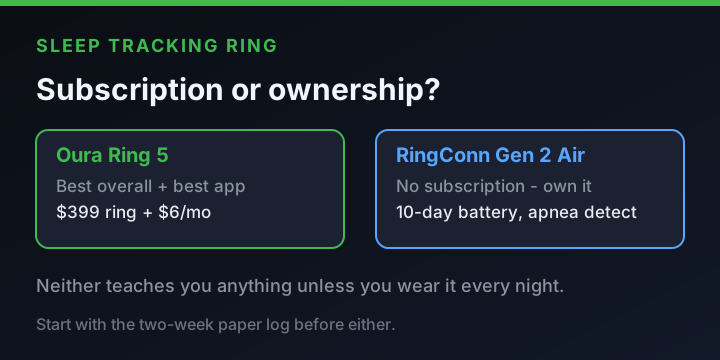
The RingConn Gen 2 Air is the strongest no-subscription alternative. It is the ultra-thin version of the Gen 2, with a 10-day battery, sleep tracking with a sleep score and detailed report, blood oxygen and heart-rate-variability monitoring, and - notably - built-in sleep apnea detection that Oura does not offer at all. The headline: no subscription fee for the core features, and the device costs meaningfully less than Oura over a few years of ownership.
The shape of the decision
- Best overall and best app: Oura Ring 5. Most validated accuracy, most comfortable, best coaching - at the cost of a subscription.
- Best no-subscription pick: RingConn Gen 2 Air. Own it outright, longer battery, sleep apnea detection - slightly less polished app.
- Skip it entirely if your only goal is “find out if my sleep is bad” - that is what the two-week paper log is for, and it costs nothing.
Verdict
The Oura Ring 5 is the best sleep tracking ring for most people - the accuracy and the app are genuinely a step ahead, and for many the monthly membership is worth it. The RingConn Gen 2 Air is the right answer if you hate subscriptions and want to own your data outright. Whichever you choose, wear it every single night: a tracker you take off on busy nights teaches you nothing.
FAQ
Is Oura’s subscription really required?
The ring works and gives you baseline sleep, readiness, and activity scores without it. The advanced data - HRV trends, body temperature, breathing-rate insights, and the personalized guidance - sits behind the membership fee. Budget for it before you buy.
What about the accuracy lawsuit?
In 2026 a class-action suit alleged Oura’s sleep-stage estimates are AI guesswork rather than direct measurements. Oura’s response is that, like all consumer sleep wearables, it estimates sleep stages from multiple physiological signals (heart rate, HRV, movement, breathing, temperature). Every wearable on the market - including RingConn - estimates stages rather than measuring them directly. Treat any ring’s sleep staging as a consistent, directional trend, not a clinical measurement.