What water filter pitchers actually remove, and when the cartridge really expires
We may earn a commission if you buy through these links — at no cost to you.
Brita Elite 10-cup pitcher, NSF/ANSI certified
Certified to reduce 99% of lead and 30 contaminants — the NSF 53 claim, not only NSF 42
Read the standard, not the badge: 42 is taste and chlorine, 53 is health. A pitcher certified only to 42 makes water taste better and is not a lead filter, and this is the listing here that makes the 53 claim explicitly. The cartridges remain the real purchase — compare cost per gallon, because cartridge life is measured in gallons, not months.
Check the current price on Amazon ›Short answer: the cartridges are the purchase, not the pitcher, and cartridge life is measured in gallons rather than months. A hydration protocol is only as good as the water you are willing to drink every day, and the cartridge is the part that quietly stops earning its keep. The pitcher is the cheap part. The cartridges are the purchase, and the marketing quietly switches units on you.
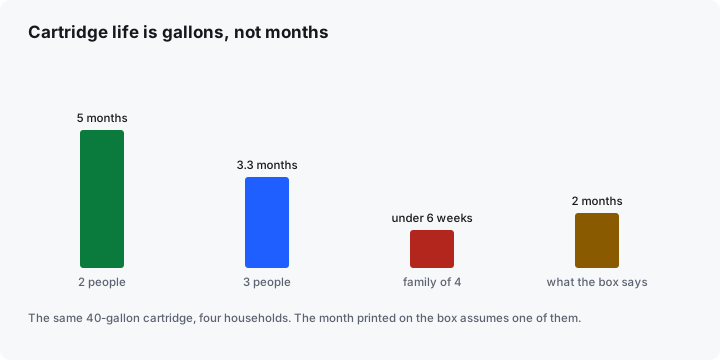
Cartridge life is gallons, not months
A cartridge rated “2 months” is rated for a gallon figure, usually 40, divided by an assumed household. Two people drinking two litres a day get through about 8 gallons a month, so 40 gallons is five months. A family of four cooking with filtered water can pass 40 gallons in six weeks.
Work out your own gallons per month before you compare cartridge prices, because the per-gallon cost is the only figure that compares across brands.
Certification, and what it is certified FOR
Look for NSF/ANSI certification, then read which standard. Standard 42 is aesthetic: taste, odour, chlorine. Standard 53 is health: lead, cysts, certain VOCs. Standard 401 covers emerging contaminants such as pharmaceutical traces.
A pitcher certified only to 42 makes water taste better and is not a lead filter. If you are filtering because of a lead concern, 53 is the only claim that answers it, and the box will say so explicitly because certification is expensive and nobody hides it.
Flow rate is the thing you will actually feel
Filters that remove more work more slowly. A 53-certified cartridge can take several minutes per pitcher, which is why they end up in a cupboard. If nobody in the house is patient, a faucet mount or an under-sink unit fits the behaviour better than a pitcher does.
What to ignore
“Alkaline” and “ionised” add-ons, which change the taste and nothing else, and TDS meters sold alongside filters, since total dissolved solids counts harmless minerals right along with anything you care about.
The order, one line
Your real gallons per month, then NSF 42 or 53 by what you are actually filtering, then cost per gallon across cartridges, then flow rate against your household’s patience.
Common questions
When should I actually change the cartridge?
Cartridge life is measured in gallons rather than months, so a household of four reaches the limit far sooner than the calendar suggests. Track roughly how much you pour, not how long it has been.
What do these pitchers actually remove?
Only what the certification says they remove, and different certifications cover different contaminants. A pitcher certified for taste and odour is not making a claim about lead.
Why has the pitcher slowed down?
Flow rate is the thing you feel first and it drops as the cartridge loads up. A slow pour is a usable signal that you are near the end of its rated volume.
Which one is for you
Pick by what you are actually filtering for, because the certification decides it, not the price:
- If lead is the concern, the NSF 53 pick is the one; nothing else on this page answers it. A pitcher certified only to 42 makes water taste better and is not a lead filter, so take the nsf 53 water filter pitcher , the listing here that makes the 53 claim explicitly.
- If taste and chlorine are the problem, the 42-certified pick is enough and costs less per gallon to run: the nsf 42 water filter pitcher .
- If your household drinks more than two people’s worth, budget for the cartridges before the pitcher. Work out your gallons per month, then compare cost per gallon across the replacement cartridges — the pitcher is the cheap part and the cartridges are the purchase.
- If nobody in the house will wait several minutes per pour, skip the pitcher format. A 53-certified cartridge can be slow, which is why they end up in a cupboard; a faucet mount or an under-sink unit fits that behaviour better.
Sized off your real gallons per month rather than the household count on the box, the 10-cup pitcher .
Where to look on Amazon
These are searches, not picks. We do not quote prices or specifications here: Amazon’s terms allow those only where Amazon itself serves the data, and a hard-coded number is wrong the week after it is written. Compare the listings against the order above.
- water filter pitcher replacement cartridges , and work out the cost per gallon from the pack size before comparing it to another brand
- water filter pitcher 10 cup , sized off your real gallons per month rather than the household count on the box
- nsf 42 water filter pitcher , if taste and chlorine are the problem, and check the listing names the standard number, not just the word certified
- nsf 53 water filter pitcher , if lead is the problem, because 42 alone is not a lead filter