Where to start with Stoicism: the reading order that survives contact with a real week
We may earn a commission if you buy through these links — at no cost to you.
Discourses and Selected Writings
The first book in the order — written by a teacher, for students
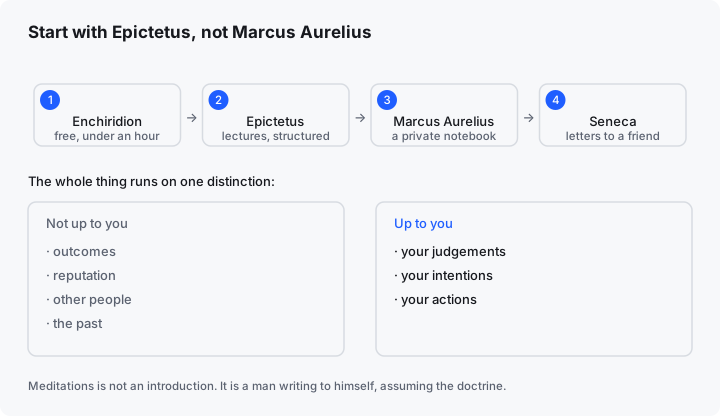
The order is the whole point. Epictetus first, because he is the only one of the three actually teaching. Marcus Aurelius is a man reminding himself and Seneca is a correspondent you overhear, so both of them assume you already have the basics. Read this one first and the other two land.
Check the current price on Amazon ›Short answer: start with Epictetus, then Marcus Aurelius, then Seneca. Most people are told to open with Meditations and quietly give up forty pages in, because Meditations is not an introduction to anything. It is a man’s private notebook, written to himself, with no intention that you or anyone else would read it. Starting there is like learning a language from someone’s diary.
Why the usual order fails
The three surviving Stoics wrote in three different formats for three different reasons, and the format is what decides whether a book works as a first book.
Epictetus taught. The Discourses and the Enchiridion are lecture notes taken by a student. They are structured, they repeat the core distinction until it lands, and they are addressed to someone who does not yet understand. That is exactly what a first reader is.
Marcus Aurelius was practising. Meditations assumes the doctrine and works on applying it, which is why it reads as fragmentary and repetitive to someone who has not met the doctrine. Read after Epictetus, the repetition stops being a flaw and becomes the point: you are watching a person fail at the same thing over and over and return to it anyway.
Seneca was writing to a friend. The Letters are the most immediately enjoyable and the least systematic. They are digressive, sometimes self-serving, and full of specific advice about grief, money, crowds, and dying. Best read third, when you can tell where he is being rigorous and where he is being charming.
The one distinction the whole thing rests on
Everything in Stoicism runs on a single split: what is up to you, and what is not. Your judgements, intentions and actions are yours. Outcomes, reputations, other people, your body and the past are not. The practice is noticing, in the moment, which side of that line a thing sits on, and spending effort only on the first side.
If you read nothing else, read the first paragraph of the Enchiridion, which states it plainly in about eighty words. Everything after is commentary.
What Stoicism is not
It is worth clearing three things out of the way, because they are the reasons people bounce off it or misuse it.
It is not suppressing emotion. The claim is that emotions follow from judgements, and that judgements can be examined. It is closer to cognitive therapy than to a stiff upper lip. Marcus writes about grief; Seneca writes an entire letter about crying.
It is not passivity. All three were politically active, and one ran an empire. The doctrine says outcomes are not yours to control, not that action is pointless.
It is not a productivity system. The modern repackaging of Stoicism as a performance technology is a genuine distortion. The texts are about how to live and how to die, and the fact that they also happen to make you calmer under pressure is a side effect, not the thesis.
On translations, which matter more than they should
For Meditations, the translation is the single biggest variable in whether you finish it. The public-domain nineteenth-century translations are free and read like a legal document. Modern prose translations are dramatically more readable and the difference is not marginal. Check the translator’s name before buying rather than the cover.
For Epictetus, look for an edition containing both the Discourses and the Enchiridion. The Enchiridion alone is a summary of a book you have not read yet, and it lands much harder after the lectures.
A cheaper first step than any of this
All four core texts are out of copyright and legally free. Before spending anything, read the Enchiridion free, end to end. It takes under an hour. If the single distinction above does not interest you after that hour, no purchase will fix it, and you have lost an hour.
Buy the paper copy when you find yourself wanting to mark it up, which is the honest signal that a book is being used rather than consumed.
The order, one line
Enchiridion free first, then Epictetus in full, then Marcus Aurelius in a modern translation, then Seneca’s letters, and a notebook somewhere in there once you start disagreeing with them.
Best overall: Epictetus’s Discourses
If you buy only one, it is the Discourses: it is the actual starting point, and the one that gives you the frame the others build on. Read it before Marcus, and let the translation decide whether the voice lands for you.
Who it is for: newcomers to Stoicism who want the single real starting point — if you only buy one book, this is the one to buy first, before the modern translations and the daily-reminder volumes.
Common questions
What is the best order to read the Stoics in?
Epictetus, then Marcus Aurelius, then Seneca. The usual order starts with Marcus, which is a private notebook and assumes the distinction Epictetus spends his time teaching.
Does the translation matter?
More than it should. These texts vary widely between translations in readability, and a dense one is the most common reason a first attempt stops at page thirty.
Is Stoicism about suppressing emotion?
No, and that reading is what makes it feel cold. The working distinction is between what is up to you and what is not, which is a decision rule rather than an instruction to feel less.
Where to look on Amazon
These are searches, not picks. We do not quote prices or editions here: Amazon’s terms allow those only where Amazon itself serves the data, and a hard-coded number is wrong the week after it is written. Compare the listings against the order above, and check the translator.
- discourses and selected writings epictetus , the actual starting point, and the one to buy first if you buy only one
- meditations marcus aurelius hays translation , read second, and the translation is the variable that decides whether you finish it
- letters from a stoic seneca , read third, the most enjoyable and the least systematic of the three
- the daily stoic ryan holiday , the modern daily-reader format, useful as a habit scaffold and not a substitute for the primary texts
- leather journal dotted a5 , because the practice is writing, not reading, and Marcus’s book exists only because he kept one
- audible premium plus free trial , the honest use for this one: the Enchiridion and Meditations are short enough to finish on a commute, and the trial covers both without buying either
- kindle unlimited free trial , worth a look only because several public-domain Stoic translations sit in it, which is a poor reason to subscribe and a fine reason to try it free
Built from the primary texts, which are freely available. We do not claim hands-on testing we have not done.