Mind optimization in order: breathing, then sleep, then anything with a battery
We may earn a commission if you buy through these links — at no cost to you.
Breath
First in the order — change how you breathe before you buy anything
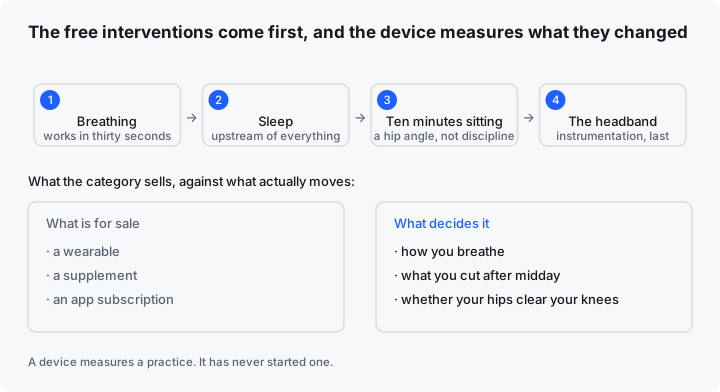
The sequence is the whole argument: breathing first, because it costs nothing and it changes the baseline everything else gets measured against. Sleep and stillness come after, and both are easier once the first one is handled.
Check the current price on Amazon ›Short answer: change how you breathe, protect your sleep, then sit still for ten minutes a day. Buy a brain-sensing headband only if all three are already habits and you want the number. The category sells devices because devices are what can be sold. The interventions with the most evidence behind them are free, unglamorous, and the reason most people never get to the part where a gadget would have helped.
Breathing is first because it is the only one that works in thirty seconds
Nothing else on this list changes your state inside a minute. Slow nasal breathing with a longer exhale than inhale is the one lever you can pull in a meeting, in traffic, or at 3am, and it needs no purchase, no app and no subscription.
The reason it belongs first is not that it is the most powerful. It is that it is the only one whose effect you can feel on the same day you try it, which is what makes the rest of the list survive past week two. Everything below this line is a slow compounding change you have to take partly on faith.
The default failure is mouth breathing, particularly overnight, and it is worth knowing whether you do it before spending on anything else.
Sleep is the intervention that makes every other one work
If you sleep badly, meditation is harder, breathing practice is harder, concentration is worse, and every measurement a device gives you is measuring your sleep debt rather than your practice. It is upstream of the entire category.
The useful part is that most sleep improvement is subtraction rather than purchase: light in the evening, caffeine after midday, alcohol at any point in the evening, and a bedroom that is warmer than it should be. None of those cost money to fix, and all four are more consequential than any supplement marketed for sleep.
The one purchase worth making early is whatever removes a specific thing waking you up. If that is a partner’s noise, or a podcast habit that means falling asleep in wired earbuds, then a comfortable side-sleeping option is a real fix rather than an optimization.
Sitting still is a posture problem more often than a discipline problem
Most people who conclude they cannot meditate have concluded it from ten minutes of discomfort in a chair or cross-legged on a hard floor. Being able to sit without your legs going numb is not a spiritual milestone, it is a hip angle, and raising your hips above your knees solves most of it.
This is the only item in the mind pillar where a cheap physical object reliably converts a failed habit into a working one. It is also the one people skip, because the practice is supposed to be free and buying a cushion feels like missing the point.
Where a device genuinely earns its place, and where it does not
A brain-sensing headband does one useful thing: it turns an invisible practice into a number you can watch move. For some people that is exactly the feedback loop that makes a habit stick, in the same way a running watch does.
It does not make you better at meditating, it does not tell you anything about your mind that a diary would not, and it will not survive contact with a practice you have not already established. Buy it as instrumentation for something you are already doing, never as the thing that will get you started.
The honest test: if you have not sat for ten minutes a day for a month, the device is not the missing piece.
What to read before you buy anything
Two books cover almost the whole pillar, and both change behaviour rather than adding tactics. One makes the case for sleep as the foundation everything else rests on. The other is about breathing, and specifically about how much of modern dysfunction traces back to breathing through the wrong hole.
Reading either one will save you more than the price of the headband, mostly by telling you what not to buy.
The order, one line
Breathe through your nose, fix the four things wrecking your sleep, get your hips above your knees and sit for ten minutes, and only then decide whether you want the number.
Common questions
Where should I start if I want to think more clearly?
Breathing, because it is the only intervention that works in about thirty seconds and costs nothing. Sleep next, then stillness, then anything with a battery.
Do the devices help at all?
Some do, in a narrow way, once the free interventions are already in place. A device that measures a problem you have not tried to fix is a subscription to a number.
How long before any of this shows up?
Breathing is immediate, sleep changes show up across a week or two, and stillness is measured in months. Ordering them this way means you get feedback early enough to keep going.
Where to look on Amazon
These are searches, not picks. We do not quote prices or specifications here: Amazon’s terms allow those only where Amazon itself serves the data, and a hard-coded number is wrong the week after it is written.
- breath james nestor , the first thing on this list to read, and the only one whose main intervention costs nothing at all
- why we sleep matthew walker , the case for sleep as the foundation under every other item here, and the reason the device is last
- meditation cushion zafu buckwheat , the cheapest object on the list and the one that most often converts a failed habit into a working one
- bone conduction headphones sleep , worth it only if something specific is waking you up or wired earbuds are the problem
- muse s brain sensing headband , instrumentation for a practice you already have, and genuinely last on this list
- audible premium plus free trial , Breath is the one to hear rather than read, since half of it is instructions you are meant to follow along with
- kindle unlimited free trial , the cheapest way to check whether Why We Sleep tells you anything your own tracker has not already told you
Written from published research summaries and the standard sleep-hygiene guidance, not from a claim that we have tested any device. We do not offer medical advice: persistent sleep problems are a conversation with a doctor, not a shopping decision.