Choosing a medication organiser for a parent living alone: what actually gets used
We may earn a commission if you buy through these links — at no cost to you.
Automatic pill dispenser with alarms
31 slots, automatic release, Bluetooth alarms, fingerprint lock
The tiers below this one remind; they cannot tell you the prompt worked. An automatic dispenser is the first tier that changes behaviour — it locks the remaining doses away and releases only the current one, which is what prevents the double dose people underestimate. If you need the last tier (somebody outside the room finds out), confirm the app actually notifies a second person before you rely on it.
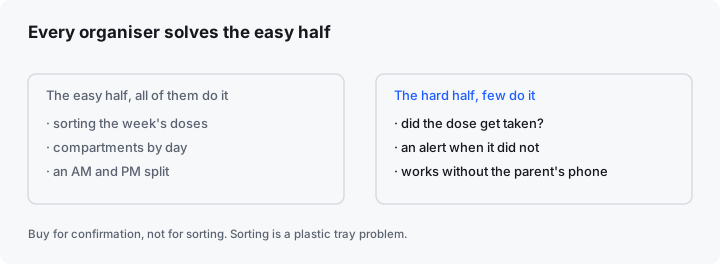
Check the current price on Amazon ›Short answer: every organiser solves the easy half, sorting the week’s doses. Buy for the hard half: knowing that a dose was actually taken.
The four tiers, and what each one actually guarantees
A weekly pill box. Sorts doses, guarantees nothing. Its real value is diagnostic: a compartment still full at bedtime tells you something, but only if somebody looks.
A pill box with an alarm. Adds a prompt, still no way to know the prompt worked. Right where the problem is genuinely forgetfulness and the person is otherwise sharp.
An automatic dispenser. Locks the remaining doses away and releases only the current one. This is the first tier that changes behaviour rather than reminding, and it is the one that prevents a double dose, which is the failure mode people underestimate.
A dispenser or app that reports to someone else. The first tier that closes the loop. Somebody who is not in the room finds out.
The failure everyone discovers late
Apps and dispensers that ask for a confirmation tap record the tap, not the dose. Caregivers of people with early cognitive decline describe the same pattern repeatedly: the confirmation is given out of habit, the log looks perfect, and the pills are still in the tray.
If the person you are buying for is fully oriented, the confirmation is fine. If they are not, a confirmation tap is not evidence, and you should choose on the physical mechanism, a locking dispenser whose remaining doses can be counted, rather than on the app’s feature list.
Five questions that decide it
- Is the risk a missed dose, a double dose, or the wrong dose? A double-dose risk points straight at a locking dispenser and rules out every open tray.
- Who needs to know, and how quickly? If nobody outside the home is monitoring, do not pay for connectivity nobody will read.
- Does it work without the internet? A device whose alarm depends on a live connection fails at exactly the wrong moment.
- Who refills it? Somebody does, every week. If that person is the one who forgets, the tier above is the honest answer.
- Does the pharmacy already offer blister packing? In many places it is free and it beats every consumer product for sorting accuracy. Ask before buying anything.
What we would not spend on
Large-capacity dispensers for a household taking three medications. Subscription features that duplicate a phone alarm. Anything that requires an older person to learn a new interface, which is the quietest reason a device ends up in a drawer.
Common questions
Which medication organiser is right for a parent living alone?
Buy for the hard half of the problem, which is knowing a dose was actually taken. Every tier sorts the week fine, and they differ almost entirely in what they can confirm.
Are the locking automatic dispensers worth it?
They are when missed or doubled doses are the real risk, because they are the only tier that both restricts access and reports. They are not when the parent manages fine and simply wants the week laid out.
What is the failure that catches people out?
Refilling. Every organiser depends on someone loading it correctly each week, and that step is where the system quietly breaks regardless of how capable the device is.
Where to look on Amazon
These are searches, not picks. We do not quote prices or specifications here: Amazon’s terms allow those only where Amazon itself serves the data, and a hard-coded number is wrong the week after it is written. Compare the listings against the order above.
- weekly pill organizer am pm , the simplest tier, which guarantees only that the week was loaded
- automatic pill dispenser with alarm , the tier that adds a prompt at the right time
- locking automatic pill dispenser for seniors , the tier that also limits access between doses
This guide is organisational, not medical. Dosing, interactions and any change to a regimen are for the prescriber and the pharmacist. Nothing described here is a medical device or an emergency alerting system.