Four books on human history that disagree with each other, and the order to read them in
We may earn a commission if you buy through these links — at no cost to you.
Sapiens
The readable one, and the one that starts the argument — first in the order
Start here because it is the one you will actually finish. Diamond and Mann then cover the same ground from different angles, and the disagreement between the three is the education — but you need the first set of claims in your head before the others can push against them.
Check the current price on Amazon ›Short answer: start with Sapiens because it is readable, then immediately read the two that undercut it, and keep the reference volume for when you want dates rather than arguments. The popular big-history books are usually read one at a time and treated as consensus. They are not consensus. They are four arguments, and reading them against each other is worth more than reading any one of them twice.
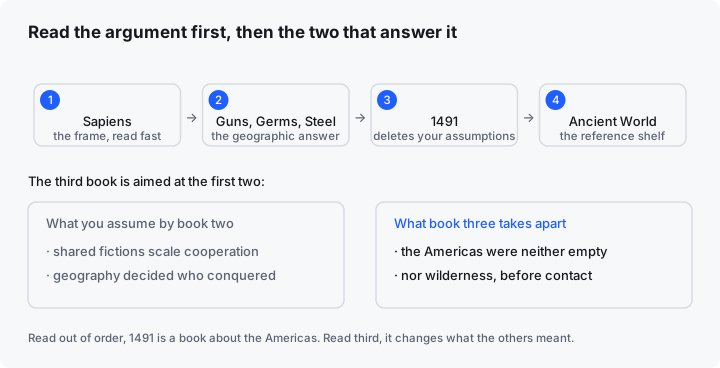
Start with the one that gives you a frame, not the one that gives you facts
Sapiens is first for a practical reason: it is the only one of the four that most people actually finish. It hands you a single organising idea, that shared fictions are what let large numbers of strangers cooperate, and it runs that idea from the cognitive revolution to the present.
Treat it as a frame rather than as a finding. Its sweep is the reason it works as an entry point and also the reason specialists object to it: at that altitude every claim is a compression of a live academic debate, and the compression always sounds more settled than the debate is.
Read it fast. Its value is the shape it leaves in your head, not the details.
Then read the one that explains why some places got rich
Guns, Germs, and Steel answers a different question, and the one most people actually have: why did some societies end up conquering others rather than the other way around. Its answer is geography, and specifically the accident of which continents happened to have domesticable animals and an east-west axis that let crops spread.
The reason it belongs second is that it is a direct alternative to reading history as a story about culture or intelligence, which is where an unaccompanied Sapiens tends to leave people. It is also heavily criticised, largely for pushing a single explanation further than it goes. Read the argument and the objection together, because the objection is where the actual history lives.
Then read the one that deletes the picture you started with
1491 is the correction, and it is the most quietly destabilising of the four. It is about the Americas before Columbus, and its argument is that the empty wilderness in the standard account was neither empty nor wilderness: it was densely populated, heavily managed land, depopulated by epidemic disease ahead of the Europeans who then described it as pristine.
Reading it third is the point. Both books above rest on assumptions about population, agriculture and land that this one takes apart, and you feel that only if you already hold the assumptions. Read out of order it is an interesting book about the Americas. Read third, it changes what the first two mean.
Keep the fourth as a reference, not as a read-through
The History of the Ancient World is a different kind of object: a chronological narrative from the earliest written records forward, told across civilisations rather than one at a time. It is not an argument, and it does not compress well.
That makes it the wrong book to start with and the right one to own. When one of the three above makes a claim about Sumer, or Assyria, or the Bronze Age collapse, this is where you go to find out what actually happened and in what order. It is the volume you read in fragments for years.
The order, one line
Sapiens for the frame, Guns Germs and Steel for the alternative explanation, 1491 to demolish what you assumed while reading both, and the ancient-world volume on the shelf for whenever you need a date instead of a thesis.
Common questions
Which book on human history should I read first?
Sapiens, because it gives you a frame rather than a pile of facts. The books that argue with it land much harder once the frame exists.
Do these four books agree with each other?
No, and the disagreement is the reason to read them in order. Each one deletes part of the picture the previous one drew.
Is one of them better as a reference than as a read-through?
Yes. Keep the fourth for looking things up rather than reading front to back, which is how most people stall halfway and stop.
Where to look on Amazon
These are searches, not picks. Editions and translations vary a great deal on these titles, so compare what a listing actually contains rather than trusting a cover.
- sapiens yuval noah harari , the frame to start with, read fast and held loosely
- guns germs and steel jared diamond , the geographic alternative, best read alongside its critics rather than alone
- 1491 charles mann , the one that takes apart what you assumed while reading the first two, which is why it goes third
- the history of the ancient world bauer , the reference volume, bought to be opened repeatedly rather than finished once
- audible premium plus free trial , these four run to well over a hundred hours in print, and Sapiens in particular survives being listened to rather than studied
- kindle unlimited free trial , the rotating catalogue occasionally carries one of the four, which makes the trial a cheap way to sample a book before committing to the hardback
These are summaries of the books’ own arguments and of the mainstream academic objections to them. We are readers, not historians, and where the four disagree we have pointed at the disagreement rather than adjudicating it.