Best office chair under $300: what to insist on, and three chairs that state it
We may earn a commission if you buy through these links — at no cost to you.
HUANUO Ergonomic Office Chair
Seat-depth adjustment, 6D armrests, high-back mesh, 4-position recline
Under $300 the specification worth paying for is the one most listings never print: seat depth. If the seat pan is too long your back never reaches the lumbar support, and no amount of cushioning fixes it. This is the chair in this bracket that states seat-depth adjustment, so check your own measurement against it before you order.
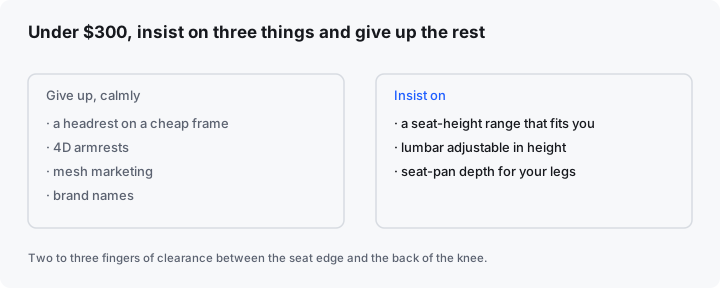
Check the current price on Amazon ›Short answer: under $300, insist on three things only: a seat-height range that fits you, lumbar support adjustable in height as well as depth, and a seat pan the right depth for your legs.
Three chairs under $300 worth comparing
Every listing below was opened and checked before this page was published, and each one states the adjustments this guide tells you to insist on. No prices are printed here — they move, and Amazon’s terms allow prices only where Amazon itself serves them — so follow the link and read the current number.
| Chair | What the listing states | What you give up |
|---|---|---|
| Ergonomic Office Chair for Long Hours and Back Pain | 4-way lumbar, 3D headrest, flip-up arms, tilt and rock, 330 lb, a stated 5-year warranty | Any brand you have heard of. The warranty is the reason to shortlist it. |
| Mesh Computer Chair, 400 lb capacity | 3D adjustable lumbar, adjustable headrest and armrests, 400 lb capacity | A stated warranty, and the widest adjustment range. |
| Ergonomic Office Chair with Footrest | 90–135° recline, adjustable lumbar and headrest, high back, 300 lb | Seat-depth adjustment, and any pretence of a small footprint. |
If your back is the reason you are here, shortlist the first one: it is the only chair of the three whose listing states both a long warranty and the full set of adjustments, which is exactly the pairing this guide tells you to read as one number.
Best office chair for lower back pain under $300
Lower back pain at this price is almost never solved by more cushioning — it is solved by getting the lumbar support to sit in the right place. That needs two things: lumbar support that adjusts in height as well as depth, and a seat pan shallow enough that your back actually reaches it. A long seat pan with a deep, fixed lumbar pad pushes you forward, which is the opposite of what you want. Of the three chairs above, the first is the only one that states a 4-way lumbar adjustment; if the seat depth is still wrong for your legs, compare it against the sliding-seat chair in the card at the top of this page.
Insist on these three
Seat height that fits YOU. Feet flat, knees near 90 degrees, thighs supported without pressure behind the knee. Chairs are built around an average height, and the cheapest way to buy the wrong chair is to ignore the published seat-height range. Shorter and taller users should read that range before anything else.
Adjustable lumbar support, in height as well as depth. Depth-only support that sits in the wrong place is worse than none, because it pushes where you are not curved.
A seat pan whose depth suits your legs. Two to three fingers of clearance between the seat edge and the back of the knee. Sliding seat pans exist at this price and are worth hunting for; where they do not, choose the correct depth rather than adjusting around it.
Work out the seat height and depth that fit you
The specification most listings omit, against the only body it has to fit.
Give up these, calmly
Headrests. Useful when reclining, mostly ignored while working, and cheap ones are placed for a neck that is not yours.
4D armrests. Height-adjustable armrests are worth having; width and pivot adjustments at this price are usually loose within a year. If you type with arms supported, prioritise a stable height adjustment over a long feature list.
Mesh everywhere. Mesh seats vary enormously; a cheap mesh seat pan with a hard front edge is less comfortable than decent foam. Mesh backs are a different matter and are usually fine.
Read the weight rating and the warranty as one number
A stated capacity far above your weight is a proxy for the gas lift and base quality, and the gas cylinder is the part that sinks first. A base rated in steel or aluminium rather than nylon survives casters better on hard floors.
Warranty length is the manufacturer’s own estimate of when it fails. Compare the warranty on the mechanism separately from the one on the fabric, because that is where the honest number is.
The trial matters more than the review
Body geometry is the variable, so somebody else’s five stars is weak evidence. Buy where the return window is at least 30 days, sit in it for a full working week, and check the return shipping cost before ordering, since chairs are heavy and return shipping can be a third of the price.
The order, one line
Seat-height range against your body, then lumbar adjustability, then seat depth, then base and gas-lift quality, then the return window.
Common questions
What should I insist on in a chair under $300?
Three things: a seat-height range that fits your body, lumbar support adjustable in height as well as depth, and a seat pan the right depth for your legs. Everything else is negotiable at this level.
What can I give up without regretting it?
Headrests, elaborate armrest articulation and mesh brand names. They are what the price bracket spends on when the three essentials are already handled, and they are also what it fakes when they are not.
Is the warranty a useful signal?
Read the weight rating and the warranty as one number. A long warranty on a low rating tells you where the manufacturer expects the chair to fail.
Where to look on Amazon
These are searches, not picks. We do not quote prices or specifications here: Amazon’s terms allow those only where Amazon itself serves the data, and a hard-coded number is wrong the week after it is written. Compare the listings against the order above.
- ergonomic office chair adjustable lumbar , adjustable lumbar support is the one feature worth protecting at this budget
- office chair adjustable seat depth , seat depth, the specification most listings omit and most people need
- petite office chair low seat height , if the standard seat-height range leaves your feet off the floor
- lumbar support cushion for office chair , worth trying on the chair you already own before replacing it, since it fixes the single most common complaint at a fraction of the cost
Built from manufacturer documentation and published ergonomics guidance. We do not claim hands-on testing we have not done.