Atomic Habits and Deep Work solve different problems, and picking the wrong one wastes a year
We may earn a commission if you buy through these links — at no cost to you.
Atomic Habits
The starting book — build the habit before optimising the attention
The page's rule is a fork, not a ranking. This is the one if getting started is your real failure; if you already start reliably and lose the afternoon instead, Deep Work is the other branch. Read whichever one names what actually happens to you.
Check the current price on Amazon ›Short answer: if you cannot get started, read Atomic Habits. If you can start but never get more than twenty uninterrupted minutes, read Deep Work. They are not two takes on the same topic and reading them in the wrong order is why one of them did nothing for you. The two most-recommended books in the category answer two different questions, and neither one says so on the cover.
Diagnose before you read
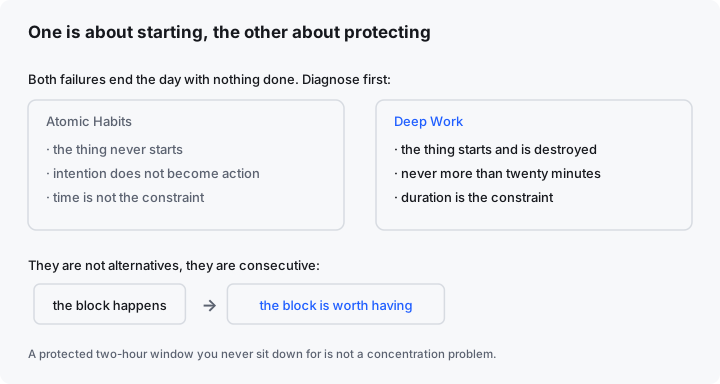
There are two very different failure modes, and they feel identical from the inside because both end the day with nothing done.
The first is that the thing never starts. You intend to write, or train, or study, and the intention does not convert into an action on most days. The friction is at the beginning, and the total time available is not the binding constraint.
The second is that the thing starts fine and is destroyed in progress. You sit down, you begin, and you are interrupted, by a message, by a meeting, by yourself, before anything with depth to it can happen. Here the binding constraint is uninterrupted duration, and no amount of motivation fixes it.
Answering which one you have takes about a minute and decides which book is worth your time.
If the problem is starting
Atomic Habits is about the first failure mode, and its central claim is that the size of the intended action is what predicts whether it happens. Shrink the action until starting is trivial, attach it to something that already happens reliably, and make the environment do the remembering rather than your willpower.
What it is genuinely good at is the mechanics: where the cue comes from, how to make the wrong behaviour slightly harder, why two minutes is the right unit. Its weakness is that it is a book about behaviour with almost nothing to say about what the behaviour should be, which is fine as long as you already know.
If you are already showing up daily and getting nowhere, this book will tell you things you are already doing.
If the problem is protecting
Deep Work is about the second failure mode, and it is more of an argument than a system. The claim is that sustained uninterrupted concentration is both increasingly rare and increasingly valuable, that it is a trainable capacity rather than a personality trait, and that most knowledge work quietly destroys it by default.
The practical half is about defending blocks of time, and specifically about treating an interrupted block as a failed block rather than as a shorter one. The part that does most of the work is the argument that the ability itself atrophies, which reframes constant task-switching as damage rather than as a scheduling annoyance.
It is a harder book to act on than the other, because its recommendations conflict with how most jobs are organised.
Where they actually connect
The honest sequence for most people is both, in this order: use the first to establish that the block happens at all, then the second to make the block worth having. A protected two-hour window you never sit down for is not a concentration problem.
That is also the reason the pairing gets recommended so often without anyone explaining it. They are not alternatives, they are consecutive.
The order, one line
Diagnose which failure you have, read the one that addresses it, and read the other only once the first problem is genuinely gone.
Common questions
Should I read Atomic Habits or Deep Work first?
Diagnose before you read. If you cannot get started, read Atomic Habits. If you can start but keep getting pulled away, read Deep Work.
Do the two books contradict each other?
No, they solve different problems. One is about making a behaviour begin reliably, the other is about protecting a block of attention once it has begun.
What if both problems apply to me?
Start with beginning, because a protected block of time is wasted if the work never starts inside it. The protection advice keeps just as well for a month.
Where to look on Amazon
These are searches, not picks. Both titles have audio and workbook editions that are quite different objects from the book, so check the format on the listing.
- atomic habits james clear , for the failure mode where the thing never starts, and the better of the two to read first
- deep work cal newport , for the failure mode where the thing starts and gets destroyed in progress
Summaries of each book’s own argument, not clinical advice. Persistent trouble starting or concentrating can have causes a productivity book is the wrong tool for.