Best first telescope or binoculars for beginners: aperture, mounts, and what actually gets used
We may earn a commission if you buy through these links — at no cost to you.
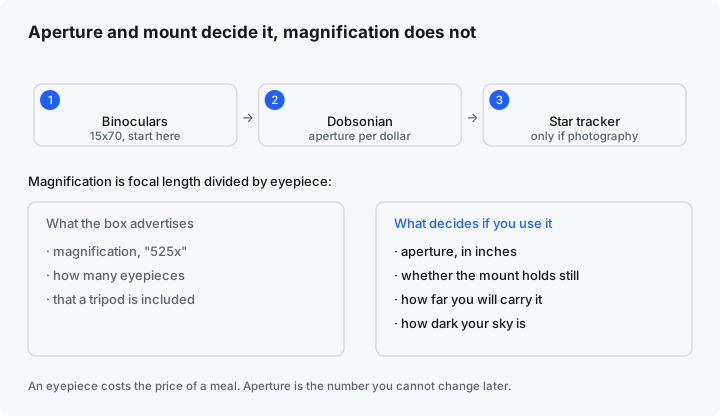
Short answer: buy 15x70 binoculars first, and if you go straight to a telescope, buy a Dobsonian and judge it by aperture, not magnification. The single most common first purchase is a small tripod-mounted refractor advertised at “525x”. It is the purchase most likely to end up unused, because the number on the box describes the eyepiece, and the eyepiece is the cheapest and least important part of the instrument.
| 15x70 binoculars | Dobsonian telescope | Cheap tripod refractor (“525x”) | |
|---|---|---|---|
| Cost | Lowest | Low-mid, aperture per dollar is unbeatable | Misleadingly cheap |
| What it shows | Moon, Galilean moons, Pleiades, Andromeda as a smudge | More light, more resolvable detail | Same sky, far less of it |
| Pointing | Point at it (no tracking) | Rocker box, the two directions your hands want | Light touch swings the image for ten seconds |
| Setup | Heavy enough to want a tripod/monopod | Large, but zero setup ritual | Small, but frustrating |
| Tracks the sky | No | No, nudge every ~20s | No |
| Likely outcome | Converts a curious person into an observer | Gets used if aperture is the spec you bought | The most common unused tube in a cupboard |
Your real fork is between binoculars and a Dobsonian, and it is decided outside the store: if you have never confirmed you enjoy standing outside in the cold in the dark for an hour, buy the 15x70 binoculars first and let them answer that for a fraction of the price. If you already know you do, go straight to the Dobsonian and judge it by aperture, not magnification. Avoid the small tripod refractor either way: the number on the box is the eyepiece, the eyepiece is the cheap and least important part, and it is the purchase that ends up unused.
Magnification is a division, not a capability
Magnification is focal length of the telescope divided by focal length of the eyepiece. You can change the second number for the price of a takeaway meal, which is why a manufacturer can print any figure it likes on the box. What you cannot change is aperture: the diameter of the main lens or mirror. Aperture decides how much light arrives and how much detail is resolvable, and every honest specification leads with it.
There is a practical ceiling too. Beyond roughly 50x per inch of aperture you are enlarging a blur rather than revealing anything, and the atmosphere usually stops you well before the optics do. A 4-inch instrument advertising 525x is claiming about four times what its own glass can deliver.
Why binoculars first is not a consolation prize
A pair of 15x70 astronomy binoculars costs a fraction of a usable telescope and shows you the things that actually convert a curious person into an observer: the Moon’s terminator in relief, four Galilean moons changing position night to night, the Pleiades filling the field, Andromeda as a real smudge you found yourself.
They also answer the question a telescope cannot answer before you buy it: do you enjoy standing outside in the cold, in the dark, for an hour? Most people who discover they do not, discover it after spending several hundred on a tube. At 15x70 the instrument is heavy enough to want a tripod or a monopod, which is worth knowing before you are holding it.
The mount is what decides whether you keep using it
A telescope you cannot point is not a telescope. The failure mode of cheap tripod refractors is not blurry optics, it is that a light touch on the focuser sends the image swinging for ten seconds, and finding anything becomes an exercise in frustration.
This is why the Dobsonian exists. It is a large mirror on a simple wooden rocker box, and it spends nothing on tripod, motors or electronics. Dollar for dollar it puts more aperture in front of your eye than any other design, and it moves in the two directions your hands already want to move.
The trade is real: it does not track. The sky drifts, so at high magnification you nudge the tube every twenty seconds or so. Many people find that fine, some find it maddening, and it is the honest reason a computerised alt-az mount is worth the money to some observers. That category buys you tracking and a go-to catalogue, at the cost of aperture for the same budget, plus batteries and an alignment routine before every session.
Astrophotography is a different hobby wearing the same clothes
This is the most expensive misunderstanding in the field. Visual observing rewards aperture. Photography rewards tracking accuracy, and almost nothing else at the start. A modest lens on a precise tracker beats a large telescope on a mediocre mount, every time.
If photography is the actual goal, the order inverts: a star tracker mount plus the camera and lens you already own, before any telescope at all. Buying a Dobsonian for astrophotography is buying the wrong instrument well.
What the sky costs you before any of this
Light pollution takes more objects off the table than any equipment decision puts back on it. Under a suburban sky, galaxies and faint nebulae are largely gone regardless of what you spend, while the Moon, the planets, double stars and bright clusters are almost unaffected.
So the cheapest upgrade available is a forty-minute drive, and the honest sequence is: check what your sky can show, then buy for that. Two free steps first, a planetarium app to learn where things are, and one clear night outside with no equipment at all to see whether you last the hour.
The order, one line
Binoculars, then a Dobsonian sized to what you will actually carry outside, then a tracking mount only if photography turns out to be the thing you want.
Best overall: the 15x70 astronomy binoculars
For almost everyone, binoculars are the honest first instrument: they get used, need no setup, and tell you whether you enjoy the hobby before you commit to a telescope and mount. They are the one to start with.
Who it is for: beginners who want something they will actually take outside — if you are not sure the hobby will stick, binoculars first; the telescopes are for the point where you know you want more aperture.
15x70 Astronomy Binoculars
15x70 — the aperture that shows deep-sky objects without needing a mount to be usable
The honest first instrument: no setup, no alignment, and you will actually take it outside. Binoculars tell you whether the hobby sticks before you spend telescope-and-mount money.
Check the current price on Amazon ›Common questions
Are binoculars really better than a first telescope?
For most beginners yes, because they get used. Binoculars need no setup, show a wide field that makes finding things possible, and stay useful after a telescope arrives.
How much magnification do I need?
Magnification is a division of the light the aperture already collected, not a capability of its own. Aperture and a steady mount decide what you can see long before the eyepiece does.
Can I do astrophotography with a beginner telescope?
Astrophotography is a different hobby using similar equipment, and the mount rather than the optics is the expensive part. Choose visual or photographic first, because a rig that does both badly satisfies nobody.
Where to look on Amazon
These are searches, not picks. We do not quote prices or specifications here: Amazon’s terms allow those only where Amazon itself serves the data, and a hard-coded number is wrong the week after it is written. Compare listings against the order above, and read aperture before magnification.
- astronomy binoculars 15x70 , the first instrument for almost everyone, and the one that tells you whether you enjoy the hobby before you commit to it
- 8 inch dobsonian telescope , the most aperture per dollar on a mount that actually works, and the standard recommendation for a first real telescope
- celestron nexstar 130slt , the computerised alternative if tracking and go-to matter more to you than aperture
- star tracker mount for astrophotography , the correct first purchase if photography rather than observing is the goal
- cosmos carl sagan , the reason a lot of people are outside in the cold in the first place
- astrophysics for people in a hurry , short, current, and the fastest route to knowing what you are looking at
Written from published optical specifications and the standard aperture and magnification relationships. We do not claim hands-on testing of specific models we have not used.