Three books on where AI goes, and the exact point where they disagree
We may earn a commission if you buy through these links — at no cost to you.
Life 3.0
The map of the whole argument — first in the order
Read this one first because it lays out the landscape the other two are arguing inside. Bostrom is the case that it goes badly by default, Kurzweil is the opposite branch; both make more sense once you already hold the map.
Check the current price on Amazon ›Short answer: read Life 3.0 first because it maps the whole argument, then Superintelligence for the case that this goes badly by default, then The Singularity is Nearer for the case that it goes well and fast. They disagree about whether capability and goals are independent, and everything else follows from that. Shelving them together as futurism hides the only interesting thing about them.
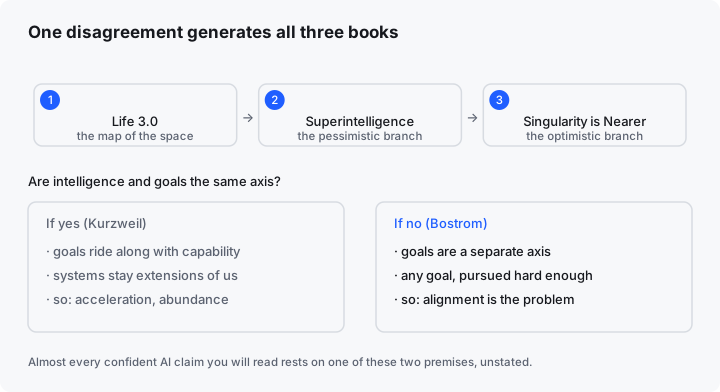
The disagreement, stated plainly
The question the three books split on is whether a system’s intelligence and a system’s goals are separate axes.
If they are separate, then an arbitrarily capable system can have arbitrarily strange goals, and nothing about getting smarter makes it get wiser. That is the pessimistic branch, and it is why the alignment problem is a problem rather than something that solves itself.
If they are not separate, if capability drags values along with it or if the systems we build stay extensions of human intent, then the picture is one of acceleration rather than danger, and the interesting questions are about timelines and abundance.
Almost every disagreement you will read about AI reduces to which of those two you find plausible. The three books are the clearest statements of each position.
Start with the map, not with either position
Life 3.0 is first because it is the only one of the three that lays out the full space of outcomes before arguing for one. It walks through the scenarios, including several nobody advocates for, and gives you the vocabulary the other two use without defining.
Reading it first means the other two arrive as positions inside a space you already understand, rather than as two confident books that seem to be about different subjects. It is also the most balanced, which makes it the worst one to read alone: balance is not a conclusion.
Then the case that this goes badly by default
Superintelligence is the book that made the alignment problem a serious topic rather than a science-fiction premise. Its core move is to take the separation of capability and goals seriously and follow it out: a system optimising hard for almost any goal, pursued competently enough, produces outcomes nobody chose.
It is dense, it is careful, and it is significantly older than the current generation of systems, which matters. Some of its assumptions about how capability would arrive have not aged well. The structure of the argument has aged fine, and that structure is why it is worth the effort.
Read it second, while the map is fresh, and read it as an argument rather than a prediction.
Then the case that it goes well, and soon
The Singularity is Nearer is the opposite branch, and it is worth reading precisely because it will annoy you if you found the previous one convincing. Its case rests on continued exponential improvement in the underlying substrate, and on the systems remaining extensions of us rather than becoming a separate thing with its own objectives.
The useful discipline is to read it looking for the load-bearing assumption rather than for the conclusion. It is a book with a very strong track record of being directionally right about hardware trends and a much weaker one about what follows from them.
What to do with the three of them
You will not come out with an answer, and any book that gives you one on this topic is selling something. What you come out with is the ability to hear a confident claim about AI and immediately locate which of the two premises it rests on, which is more useful than a forecast and considerably more durable.
The order, one line
Life 3.0 for the map, Superintelligence for the pessimistic branch taken seriously, The Singularity is Nearer for the optimistic one, and the disagreement between the last two is the actual subject.
Common questions
Which of the three books should I read first if I only read one?
Life 3.0. It maps the whole argument, including the positions it does not hold, so you can place the other two without having read them.
Do I need a technical background to follow them?
No. All three are written for a general reader and the disagreement between them is about values and timelines, not about mathematics.
Are these books outdated given how fast AI moves?
The specific capability examples age quickly. The structure of the disagreement does not, which is why the reading order is by argument rather than by publication date.
Where to look on Amazon
These are searches, not picks. Kurzweil in particular has several similarly-titled books across two decades, so check the publication year on the listing.
- life 3.0 max tegmark , the map of the whole argument, and the right place to start
- superintelligence nick bostrom , the case that this goes badly by default, dense and older than the current systems
- the singularity is nearer kurzweil , the opposite branch, read for its load-bearing assumption rather than its conclusion
- audible premium plus free trial , Bostrom is the one people abandon, and hearing it read is the difference between finishing it and shelving it at chapter four
- kindle unlimited free trial , useful here mainly for the search function: all three books argue with each other, and finding the passage you half-remember is easier in text
Summaries of each book’s own argument. We hold no position on which branch is right, and anyone who tells you the question is settled is describing their confidence rather than the evidence.